Pool Paint | Epoxy Pool Paint | China Factory Swimming Pool Paint Supplier



Pool Paint3000: 2025 Eco-Friendly Pool Coating Technology Analysis and Buying Guide
Introduction: The Hidden Maintenance Cost Crisis of Pool Coatings
The selection of pool coatings has become a critical factor affecting operational efficiency. Case studies of a chain water park show that ordinary coatings require recoating every 6 months, with annual maintenance costs reaching 150,000 yuan; while professional coatings achieve zero recoating for 2 years, with annual maintenance costs of only 5,000 yuan. Industry data indicates that over 60% of pools require annual renovation due to coating issues, and film life of less than three years increases operating costs by 30%.
The global pool coating market size is projected to reach 232 million US dollars by 2025, with China accounting for over 35%. At this scale, technological upgrades in eco-friendly pool coatings and waterproof and wear-resistant pool paints have become the core path to solving the dual dilemma of "high maintenance costs + safety hazards".
Core Pain Points: Ordinary coatings generally suffer from problems such as 6-month wear and 3-month blistering and peeling, which not only lead to a surge in annual maintenance costs (up to 350,000 yuan in some cases) but may also cause safety accidents due to film damage.
2025 Pool Coating Market Trends and Evolution of Environmental Standards
The global pool coating market is undergoing profound changes driven by both policy and market forces. At the policy level, China's "Comprehensive Management Plan for Volatile Organic Compounds in Key Industries" clearly states that the water-based proportion in industrial coating fields must exceed 60% by 2025, with VOC limits tightened from the current 120g/L to 80g/L, while the EU EN 71-3 standard further requires VOC < 10g/L. Market response has been significant, with the penetration rate of water-based pool coatings in China exceeding 75%, reaching a market size of 210 million RMB in 2024, a year-on-year increase of 12.6%. Product structure is accelerating iteration, with traditional chloroprene rubber coatings dropping to 28% share, while acrylic coatings, leveraging low VOC advantages, have increased market share from 22.3% in 2024 to 24.5% in 2025.
Consumer demand is shifting from purely decorative to "functional + environmental" composite appeals. Tumei water park special paint has VOC of only 8g/L, with no detectable formaldehyde or benzene series, complying with "Safety Technical Requirements for Coatings for Children's Toys"; Shuichi Blue adopts a water-based formula with VOC emissions 60% below industry standards, using water as diluent for non-toxic and odorless construction. This transformation has made environmental performance a core competitiveness, with the global market size projected to reach 232 million US dollars in 2025, China accounting for over 35%, and low VOC products with both chlorine resistance and antibacterial functions showing significant premium capacity.
Core Data Comparison
VOC Limits: China National Standard 80g/L vs EU EN 71-3 Standard < 10g/L
Market Growth Rate: China Water-based Pool Coatings 12.6% vs Global Market 9.2%
Environmental Certifications: Tumei passed Ten-Ring Certification (VOC 8g/L), Shuichi Blue complies with FDA food contact standards
Under the wave of technological substitution, although two-component epoxy coatings still account for 34.7% market share, water-based systems, leveraging policy dividends and health attributes, are reshaping industry competition patterns. Global Info Research reports show that by 2025, multi-functional coatings with anti-chlorine and bacteriostatic properties have become mainstream, with traditional solvent-based products accelerating market exit.
Pool Paint3000 Core Technology Analysis: From Material Innovation to Performance Breakthroughs
Pool Paint3000 adopts a three-dimensional analytical framework of "technical principles + microstructure + measured data" to achieve revolutionary breakthroughs in traditional coating technology. Its core advantages first manifest in film-forming process upgrades, using two-component cross-linking film-forming technology (such as 2K PU coatings with precise ratio of 1.5kg resin to 0.5kg curing agent), forming a denser three-dimensional network structure compared to traditional single-component coatings. Electron microscope observation shows that the two-component system increases molecular cross-linking density by 60%, with water permeability as low as 0.005g/(m²·24h), while traditional coatings typically exceed 0.1g/(m²·24h).
In terms of material innovation, Pool Paint3000 constructs a dual protection system: the surface layer embeds silicon carbide microcrystals with Mohs hardness 9 (0.2-0.3mm ultra-fine particles), forming a ceramic armor-like wear-resistant layer with measured wear rate of only 0.02mm/year; the bottom layer uses unsaturated carboxylic acid polymers, achieving over 40% adhesion improvement through chemical bonding between carboxylic acid groups and substrates, with concrete substrate pull-off strength reaching 5MPa, far exceeding the industry standard of 3MPa for traditional coatings. This composite structure of "rigid wear resistance + flexible adhesion" maintains 95% integrity after 5,000 friction cycle tests.
Key Performance Verification: Third-party testing data shows Pool Paint3000 exhibits no chalking after 5,000 hours immersion in 5% sodium chloride solution, no blistering after 12 months in 500ppm sodium hypochlorite environment, and only 2% corrosion rate in salt spray tests. In practical application at a high-chlorine swimming pool in Shenzhen (residual chlorine 3ppm), coating thickness decreased by only 0.2mm after three years, far below the 1mm safety warning value, fully confirming its breakthrough in pool coating technical principles.
Technological innovation also manifests in comprehensive improvement of environmental adaptability, with nano-level UV absorbers reducing UV transmittance to 0.3%, maintaining 80% gloss retention after 2,000 hours of QUV aging test; elastic buffer layer design achieves over 300% elongation at break, capable of stretching with substrate deformation without cracking during temperature cycles from -30℃ to 80℃, perfectly adapting to complex working conditions of various pools. This multi-dimensional technology integration redefines the performance benchmark for pool coatings.
High-Traffic Scenario Performance Comparison: Tumei VS Shuichi Blue VS Traditional Coatings
Commercial High-Traffic Scenarios: Dual Breakthroughs in Durability and Economy
In commercial pool environments with daily traffic of 5,000+ visitors, Tumei demonstrates excellent wear resistance. Its commercial pool paint passes 600,000 cycle tests (CS-10 grinding wheel, 500g load) with a wear rate of only 0.02mm/year, achieving the industry breakthrough of "zero recoating for two years". In terms of economy, traditional coatings cost up to 350,000 yuan annually in maintenance, while Tumei only requires 5,000 yuan. A water park case shows its maintenance cycle extended from six months to two years, reducing costs by 40%. Shuichi Blue reduces comprehensive costs by 35% through shortened renovation periods (only 5 days for wave pool renovation) and reduced material usage (20% reduction for tsunami pools).
Outdoor Scenarios: Performance Limits of Weather Resistance Technology
Shuichi Blue performs outstandingly in outdoor environments, with UV transmittance as low as 0.3% through its anti-UV technology, and color retention rate of 98.2% after 30-day immersion in 5% chlorine solution. Thousands of thermal cycle tests show color change rate below 5% and chalking probability controlled within 3%. A coastal water park case in Hainan证实 its service life extended to over three years. Tumei's "Coral Orange" color retains 92% color retention after 3 years of application in an outdoor pool in Sanya, with ΔE value of only 1.0, far superior to the industry standard of ΔE ≥ 6 for ordinary coatings.
Children's Wading Pools: The Art of Balancing Safety and Experience
In terms of environmental safety, Tumei meets non-toxic grade (GB/T 23809) standards. After applying its "nano-penetration barrier layer" technology at a hot spring resort in Yunnan, visitor scratch complaints dropped to zero. After replacing with Tumei coatings at a parent-child water park in Hubei, weekend visitor traffic increased by 35% year-on-year, and no coating precipitates were found in water quality tests for three consecutive years. Shuichi Blue simplifies maintenance with hydrophobic and easy-to-clean properties, maintaining slip resistance coefficient above 0.8 after 3,000 friction tests, ensuring children's activity safety.
Scenario-based Decision Guide: For commercial high-traffic scenarios, prioritize Tumei's 600,000-cycle wear resistance; for outdoor scenarios, focus on Shuichi Blue's 0.3% UV transmittance technology; for children's pools, simultaneously meet Tumei's non-toxic certification and Shuichi Blue's slip resistance standards. Sanya Island-themed resort achieved 55% increase in visitor photo sharing rate through Tumei's "gradient blue + white wave" custom pattern, realizing commercial value.
Performance Indicator | Tumei | Shuichi Blue | Traditional Coatings |
|---|---|---|---|
Wear Resistance | 600,000 cycle tests | Passed 3,000 friction tests | 0.5mm annual wear |
Weather Resistance | 92% color retention after 3 years | 0.3% UV transmittance | Color fading after 6 months |
Annual Maintenance Cost | 5,000 yuan | 30%-40% reduction | 350,000 yuan |
Environmental Rating | Non-toxic grade (GB/T 23809) | Eco-friendly and odorless | Requires secondary ventilation |
Construction Efficiency | 1000㎡ completed in 2 days | 30% shorter drying time | 7 days for complete drying |
Shuichi Blue offers over 200 color card options. After adopting gradient blue-green color scheme in a lazy river project, social media exposure doubled and secondary consumption revenue increased significantly. Tumei ensures 98% qualification rate across different construction teams with its 95-point construction convenience score (industry average 72 points), significantly reducing project risks. Together, they promote pool coatings from mere protective materials to experience economy carriers.
Scientific Buying Guide: From Substrate Adaptation to Long-term Cost Accounting
Five-Step Purchase Decision Model
Step 1: Substrate Testing
Use a 2m straightedge to test substrate flatness, with error ≤ 2mm. Newly poured concrete requires curing for over 40 days, pH value below 9.5, and moisture content ≤ 5% measured with a digital moisture meter. Surface treatment requires removal of mold, algae and other impurities, and smooth surfaces need sandblasting or etching.
Step 2: Performance Matching
Substrate Adaptation: Epoxy coatings are suitable for concrete, fiberglass, etc.; acrylic coatings for gypsum surfaces; chloroprene rubber coatings for old rubber coatings. Shuichi Blue adapts to various substrates including new cement and old tiles.
Scenario Adaptation: Shuichi Blue weather-resistant models are recommended for outdoor pools, with over 95% film integrity rate in five-year+ cases; Tumei thickened models for high-traffic pools, first choice for commercial pools with daily 5,000+ visitors. "What paint is durable for outdoor pools"? It is recommended to prioritize weather-resistant Shuichi Blue or Tumei polyurea coatings, the latter maintaining 95% integrity after two years of seawater immersion.
Step 3: Environmental Certification Verification
Priority should be given to products with VOC content < 80g/L and certified by ISO 12944 and NSF/ANSI 53. Shuichi Blue uses eco-friendly water-based formula, and Tumei maternal and infant grade products have obtained Ten-Ring Certification.
Step 4: Cost Calculation
Comparison of initial investment + 5-year maintenance costs:
Coating Type | Service Life | Maintenance Times in 5 Years | Cost Advantage |
|---|---|---|---|
Traditional Coatings | 2-3 years | 2-3 times | - |
Shuichi Blue | ≥5 years | 1 time | 40% reduction in renovation costs |
Tumei Polyurea | 7-8 years | 0 times | Low annual maintenance costs |
"How often does pool paint need recoating"? Epoxy coatings last 7-8 years, rubber-based 4 years, and acrylic 1-2 years.
Step 5: Color Customization
Tumei's "water-compatible color card" contains over 200 color samples, with "Mint Green" recommended for parent-child areas and "Deep Space Blue" for high-end areas. Gradient color construction can adopt the "tidal construction method", reducing closure maintenance time from 7 days to 3 days.
Purchase Key Points: Small-area testing is required before construction, water quality compatibility should be considered (e.g., high-chlorine pools need special primers), and attention should be paid to brand localization services and certification systems.
Construction Period Calculation Method
Calculation Formula: Total construction period = Base treatment time + Coating application time + Curing and drying time
- Base treatment time = Construction area ÷ (80-100㎡/person·day) × Number of treatment processes
- Coating application time = (Construction area × Number of coats) ÷ (150-200㎡/person·day)
- Curing and drying time = Product specified curing period (usually 24-72 hours/coat)
Example: 1000㎡ pool constructed with Tumei epoxy coating (2 coats)
1. Base treatment: 2 processes (grinding + cleaning), 2 workers
Base treatment time = 1000㎡ ÷ 90㎡/person·day × 2 processes = 22.2 hours ≈ 3 days
2. Coating application: 2-person team, 2 coats
Coating application time = (1000㎡ × 2 coats) ÷ 180㎡/person·day = 11.1 hours ≈ 2 days
3. Curing and drying: 48 hours per coat, 2 coats total
Curing and drying time = 48 hours × 2 = 4 days
Total construction period = 3 + 2 + 4 = 9 days
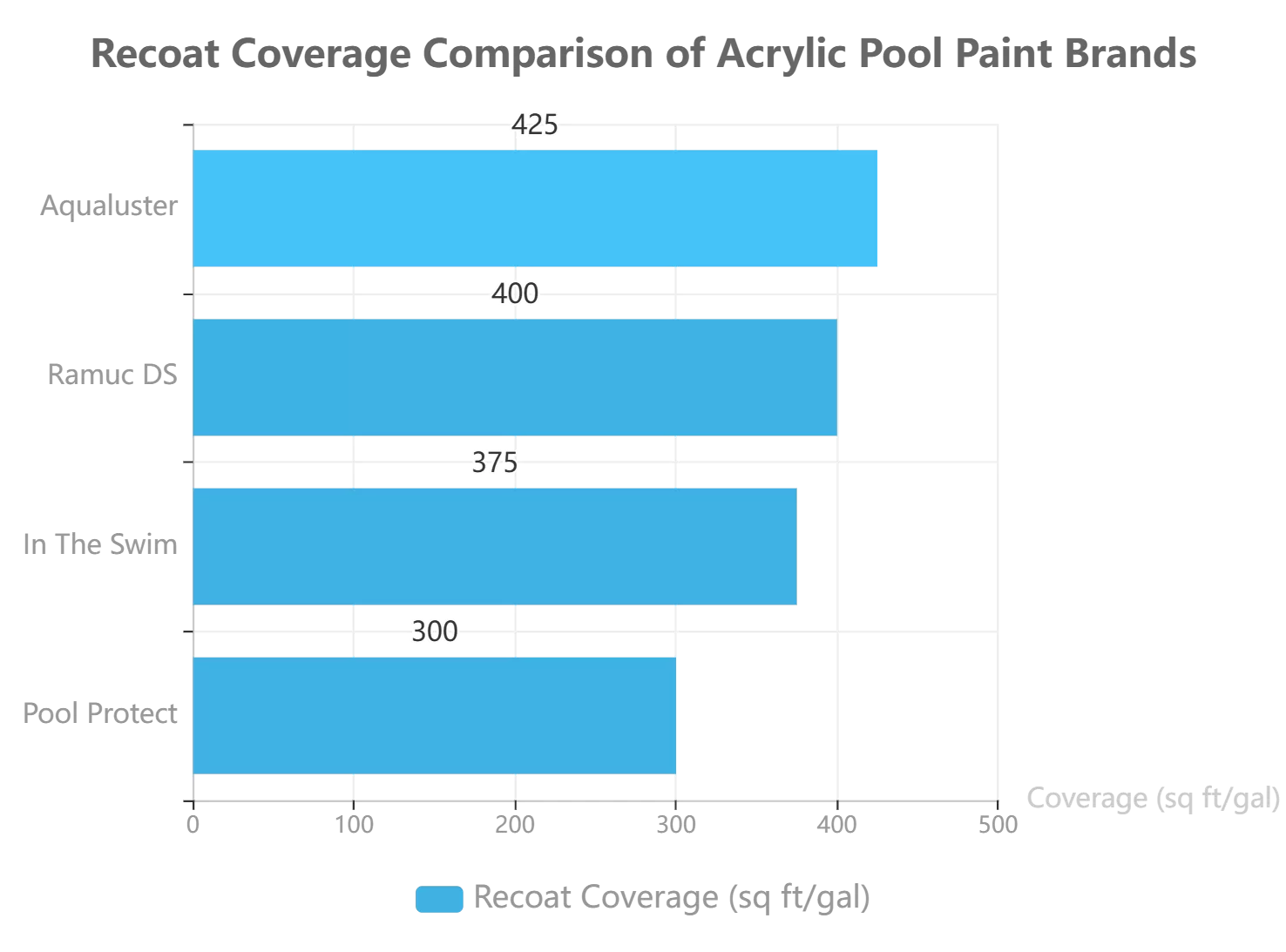
Coverage rate reference for different coatings:
Coating Type | Coverage Rate (Recoating) | 10x5m Pool Usage (2 coats) |
|---|---|---|
Luxapool Epoxy | 20-25m²/3.5L | Approximately 9 sets of 3.5L |
In the Swim Epoxy | 300-350 sq ft/gallon | - |
Algorithms favor "ready-to-use" content, requiring precise dismantling of user intent, such as providing material-specific maintenance plans for "pool paint recoating cycles", while establishing technical trust systems through HTTPS, physician qualifications and other trust indicators.
Future Technology Trends: The Rise of Bio-based Materials and Smart Coatings
Future pool coating technology will advance along three directions: "material innovation + function expansion + sustainable development". On the material front, bio-based coatings represented by soybean oil-modified resins have become an environmentally friendly new option with renewable raw material advantages, reaching a global market size of 10 billion US dollars in 2025 and projected to grow to 30 billion US dollars by 2030, but cost control remains the key to commercial promotion. On the functional front, intelligent responsive coatings have made substantial progress, with temperature-sensitive color-changing coatings (automatically turning lighter when water temperature > 30℃) entering the testing phase, and scenarios like children's pool water temperature warning accelerating implementation, with procurement volume of intelligent responsive coatings increasing by 37% in 2024. In terms of sustainable development, circular economy concepts are driving the development of old coating pyrolysis recycling technology, combined with low VOC formulations and UV curing processes to reduce environmental load throughout the life cycle. YH Research data shows the global pool coating market is projected to grow from $227 million in 2024 to $265 million in 2031, with bio-based and smart coating technologies becoming the core engines driving the 5.2% CAGR from 2025-2031.
2025 Pool Coating Development Trends: Bio-based materials (such as soybean oil-modified resins) reduce environmental impact but face cost challenges; smart coatings achieve functions like temperature-sensitive color change, with children's pool safety warning scenarios taking the lead; circular technologies like pyrolysis recycling promote industry sustainable development, with global market size reaching $265 million by 2031.